
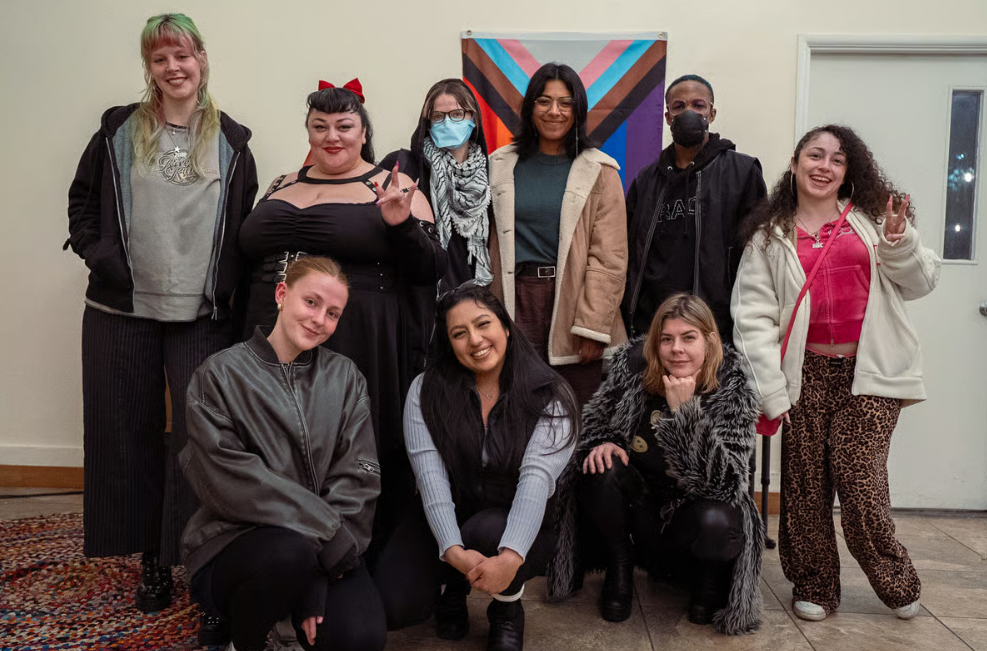
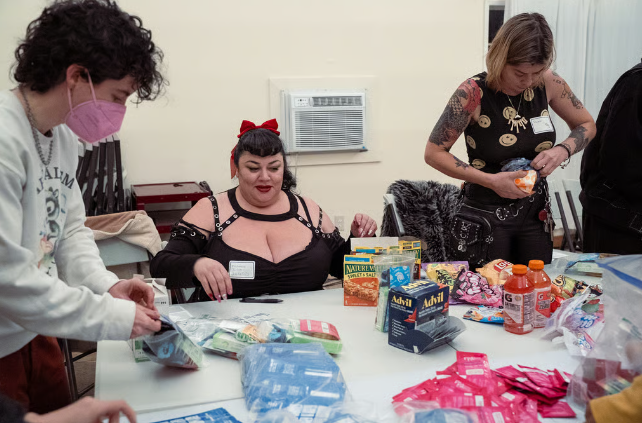
On a Tuesday evening in mid-February, a dozen people filtered into a meeting hall at a church in Los Feliz. They introduced themselves one by one: a professional dominatrix, a comedian, a nurse, and a medical student. Piled onto a table at the center of the room were Narcan, lube, menstrual pads, Advil, condoms, and candy.
This was not a Bible study group. This was the monthly general meeting for the Los Angeles chapter of the Sex Worker Outreach Project, or SWOP LA. One of the few sex worker-led nonprofits in LA, SWOP assists nearly 300 local sex workers in the region each month through programs like its Sex Worker Abortion Navigation Services and “bad date” list of dangerous clients to avoid. At this meeting, volunteers packed care kits to distribute during “the stroll,” their outreach to street-based sex workers on Figueroa Street in South Central.
For years, the SWOP model has embraced peer-to-peer mutual aid over charity, a grassroots approach that centers dignity, privacy, and the autonomy of people who participate in the commercial sex industry that is still illegal in the United States. But the work is growing more challenging with funding questions and increased criminalization of sex work in Los Angeles.
Ahead of LA hosting the FIFA World Cup and 2028 Summer Olympics, city and county law enforcement have been targeting human sex trafficking by shutting down motels, sending “Dear John” letters to the home addresses of customers, and installing cameras on known blades where sex is sold on the dark corners of busy streets like Figueroa and Western.
The increased interest and awareness about sex work has put the onus on SWOP LA to educate and inform the public that sex trafficking increasing during world sporting events is a myth and that law enforcement surveillance can force commercial sex workers into more precarious situations.

“We’re battling increased trafficking paranoia as we’re getting closer to these big sporting events,” said Kimberly Fuentes, SWOP LA’s director of research and services.
Fuentes said increased police activity hasn’t stopped sex work or sex trafficking, but has made it harder for her and volunteers to do outreach on Figueroa as sex workers are dispersing to other blades to avoid law enforcement.
“Because we are a sex worker-led org we find ourselves kind of often stretched,” said Fuentes.
Funding for the organization’s abortion services is also in limbo as SWOP LA waits to see if the California state legislation will renew a grant that has funded abortion services for sex workers since 2023. The Los Angeles County Abortion Access Safe Haven Pilot Program grant gives the organization around $75,000 a year, more than one-third of the small nonprofit’s $180,000 annual budget.
Bridging the gap between institutional resources and community needs
Ayako Miyashia Ochoa, a professor of social welfare at UCLA, said organizations like SWOP fill a huge gap in safety net systems.
“When we hit lean times, philanthropy cannot pick up the slack, because the stock market has been affected,” Ochoa said. “[People] have to go back to centering power in community, for community, by community and thinking through where resources lie.”
She said SWOP LA’s mutual aid approach allows it to be more nimble and effective in addressing needs that can’t be met by charity or government agencies.
“Our best intentions are taken over by bureaucratic tendencies,” said Ochoa, who also serves as co-director of the UCLA Hub for Health Intervention, Policy and Practice. “Systems of support create really rigid rules around eligibility for public benefits.”
Sex workers often face social stigmas and other barriers when they try to access government or nonprofit resources if they have a criminal record or disclose what they do for work, according to Ochoa. In comparison, SWOP LA doesn’t ask for identification or check someone’s income history to evaluate whether someone qualifies for help.
“Decreasing those barriers to care and support is critical for someone who’s in the most precarious of circumstances,” said Ochoa.
Sex work looks different for everyone — from full service to cam modeling — and the needs can look very different. Mistress Julia Juggs, whose two decade career in the commercial sex industry has spanned online adult acting and print erotica, drives out from the suburbs of the San Gabriel Valley every month to attend SWOP’s in-person meetings because they are so important for her mental health.
“Being a sex worker sometimes is very lonesome,” Juggs said of the long hours she can spend at home alone in front of a computer interacting with customers online. “Community is so important.”
It’s SWOP LA that inspired Juggs to go back to school to become a medical billing and coding specialist after taking “Build A Bimbo” workshops hosted by another sex worker in SWOP LA.
“I do celebrate my sex work, because sex work has empowered me in so many ways,” Juggs said. “[But] I want something I can retire on.”
Pixie, another regular attendee of SWOP LA’s monthly meal gatherings, which are known as “munch,” said that while she was facing homelessness, it was her fellow escorts that stepped in to help her.
“If I was staying with an unsafe person, they would be like, ‘I know you’re kind of homeless right now. Just come stay with me in my room for like three months, and we’ll figure it out later,’” Pixie said.
Mutual aid and community powers SWOP’s operations through financial uncertainty
As the need for services has grown over the years, so has SWOP LA’s capacity. At the onset of the Covid-19 lockdown, sex workers weren’t able to solicit in-person clients, which sparked SWOP LA’s crowdfunding campaign that ultimately raised $20,000 for emergency grants. In 2023, SWOP LA officially became a nonprofit that could apply for grants and accept tax exempt donations. Many of its current grants address STI and HIV prevention in LGBTQ populations that happen to be sex workers.
The organization managed to weather the DOGE budget cuts that cratered funding for public health at the start of President Trump’s second term in 2025.
“We are in a bit of a lucky position where none of our funding was federal,” Ashley Madness, SWOP LA’s fundraiser and secretary, said of their grants that are funded on a local and state level.
There’s already a dearth of sex worker-specific funding, and Madness said SWOP LA often has to turn down opportunities to protect the privacy of sex workers, including one grant that would have required people to scan their fingerprints with the Department of Justice.
“We’re not willing to bend that. We’re much more comfortable getting down and getting dirty and getting scrappy again,” Sophia Coleman said of SWOP LA’s refusal to work with law enforcement. “Sex workers are a group of people that have always kind of worked outside of whatever formal structures previously existed.”
According to Madness, SWOP LA was supporting sex workers long before receiving any external grants.
“Before 2020 we’d usually maybe clear $5,000 in a year from our donations at the potlucks,” Madness said.
Coleman, who directs outreach and education at SWOP LA, said she’s unfazed by the latest funding challenges.
“We’re trying to build out a network of people, so that even if we don’t have funding, we can refer you to somebody who does,” Coleman said of SWOP LA’s connections to county and citywide health care providers.
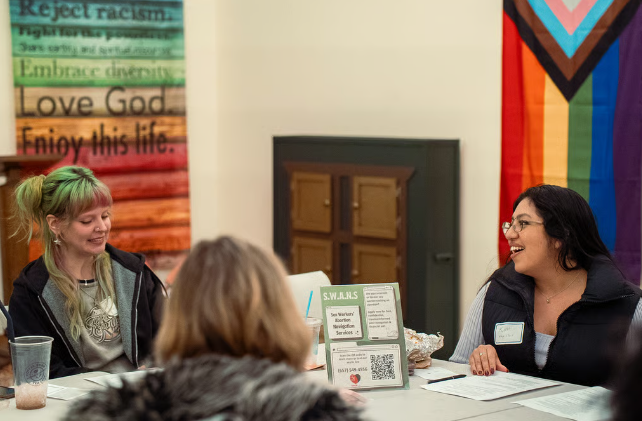
Coleman said the key to SWOP LA’s success is its horizontal leadership. Coleman and six other steering committee members share responsibility for running SWOP LA’s different programs. Everyone’s specific skillsets — including Fuentes’ research background and Madness’ law degree — contribute to the organization’s advocacy and direct services on behalf of their own community.
“We are able to translate these things that the ivory tower is gatekeeping and are able to implement them,” said Sophia Coleman, who joined SWOP LA five years ago while finishing her master’s in public health. “It’s the ability to live between both of these worlds that give SWOP LA the real power that it has.”
Coleman said SWOP LA stays true to its mission because the work is a labor of community love. Steering committee members like Fuentes are only paid a monthly stipend of $600 while donating an average of 200 hours every month.
“It’s not necessarily about the money, it’s about where we can see our tangible impact, and that really keeps a lot of us going in this work,” Coleman said. “We are impacted by the same things that we are trying to impact.”
Breaking down stigma and educating the public about sex work
It’s not easy educating the public about sex work when there’s so much stigma and conflation between sex work and sex trafficking, said Fuentes, who has helped to author multiple academic papers on sex workers in Los Angeles.
“When I was reading a lot of scholarship, it felt very lonely,” said Fuentes, who has studied the sexual health of sex workers who are stopped by law enforcement for carrying condoms. “We see a lot of scholarship and just general academic work happening about sex workers with not a lot of sex worker input.”
The reasons why people consensually enter the sex trades are personal and nuanced. For some, the choice arrives from the lack of economic opportunities afforded to undocumented, queer (particularly transgender) people and those with disabilities, said Fuentes.
“Where people typically encounter barriers in the typical employment market, they might not encounter those barriers within the sex trade,” Fuentes said. “If you actually care about these women, you understand that they can’t just switch jobs.”
Hazel, a new SWOP LA recruit who provided LA Public Press her working name that she uses with clients, said she was in a life changing car accident in 2017 that led to short-term memory loss and seizures. She said she ended up losing her job as a car mechanic because of her brain injury.
“Working as a mechanic is like being a contortionist and a weightlifter at the same time,” Hazel said. For her, sex work is easier on her body. “Sex work is like stretching, breath work, little bit of yoga.”
As a result of sex worker advocacy, California’s laws in recent years have moved away from targeting working women by banning police from arresting people they suspect of loitering to solicit prostitution and granting immunity to sex workers reporting a violent or serious felony.
But Fuentes said LA’s efforts to target clients and pimps, a strategy often referred to as the “end demand,” or Nordic model, still puts sex workers into precarious work situations, especially when they’re forced to leave familiar areas of work in favor of more isolated and hidden spaces to avoid surveillance.
“A lot of women in the sex trade who might be escaping trafficking situations will not seek help from the police, or will not seek help from trafficking organizations because they are scared that they’re going to get arrested,” Fuentes said.
SWOP LA’s focus is on trauma-informed, harm reduction and non-carceral solutions to help victims of sexual harm and trafficking. Its monthly meetings are public, a delicate balance in visibility, to spread awareness while not becoming the target of scrutiny.
Allies like Paulina, a local medical student who declined to share her last name for privacy reasons, attended the February meeting to learn more about how she could help.
“Sex workers are a group of people that have historically been kind of left out of the conversation with reproductive rights,” said Paulina, who is studying to be an OBGYN. She said she is concerned about the lack of research and informed care that is impacting the quality of medical care that sex workers receive that is impacting the quality of medical care that sex workers receive. “There are high rates of HIV, STD, and unintended pregnancies among sex workers.”
SWOP LA has become a space where Paulina can learn how to align her future practice with centering the needs of marginalized communities like sex workers.
“I want to connect with community members in spaces that are meant for them and not in like healthcare systems, where the power dynamic is evident,” Paulina said.
At the end of February’s general meeting, more than just care packages had been assembled: new friendships and community bonds had been strengthened. Volunteers offered to set up a Signal group chat to stay connected.
For Hazel, who had only moved to Los Angeles in January, the meeting felt like a lifeline.
“I felt more confident in myself as a sex worker in LA after I went to the meeting,” said Hazel. “I’m not used to the warmth I felt at that meeting.”
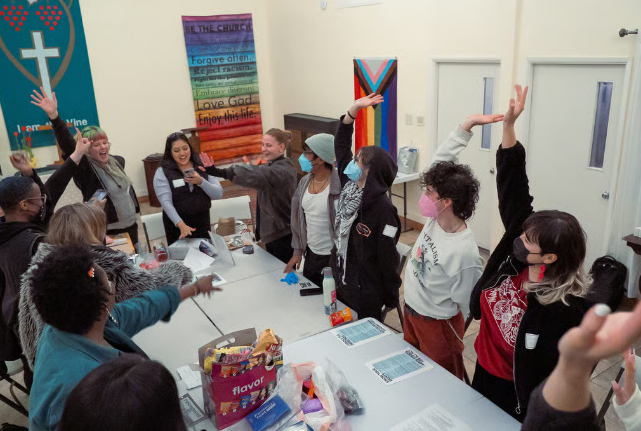
In closing the meeting, Fuentes rallied everyone into a final team break.
“On three with me,” she said. Everyone placed their hands in the center and shouted in unison: “Sex work is work!”