For most of LA County, June 2 was Election Day. But those gathered at the Los Angeles LGBT Center that evening were celebrating a different occasion — International Whores’ Day.
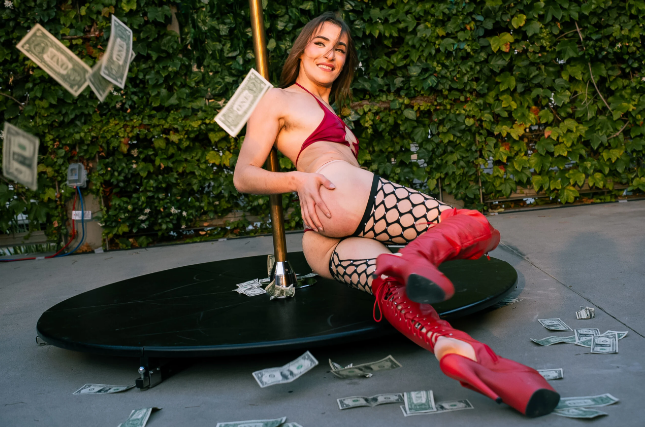
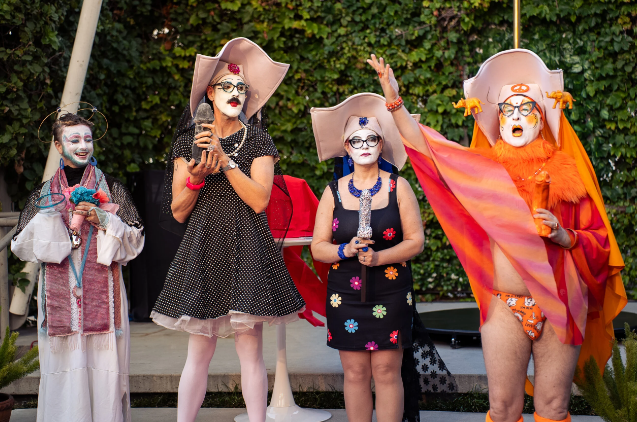
While poll workers collected ballots across the street, a pole dancer spun to an adoring audience who showered her in dollar bills. The Sisters of Perpetual Indulgence, draped in glittery robes, offered a phallic blessing.
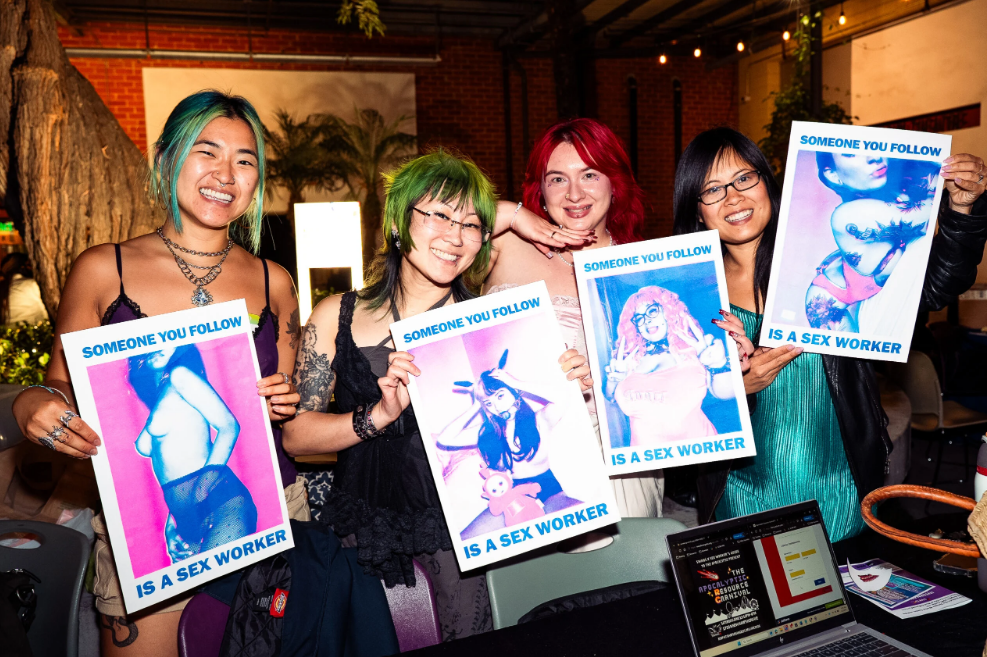
Organizers passed out sex worker know-your-rights pamphlets in a courtyard. Inside the Renberg Theatre, a panel of queer and transgender sex workers and activists spoke about human rights issues in celebration of Pride Month.
This free event, the first of its kind, was sponsored by the One Institute, the Stripper Worker Center, the Los Angeles LGBT Center, and the City of West Hollywood. It was an unapologetic celebration of the contributions of sex workers to the rights of queer people.
“I could not be more proud to be a whore among whores,” said Antonia Crane, the founder of Strippers United, a labor advocacy group for and by exotic dancers. The seated crowd cheered in response. “This event is a breakthrough, and it’s very significant for us … at this time in history, when we are all under attack.”
International Whores’ Day began 51 years ago in Lyon, France when more than 100 sex workers occupied a church in protest of police harassment and poor working conditions. Today, sex workers are still marginalized in the U.S., where sex work is illegal in every state besides Nevada, where brothels are sanctioned, and Maine, where sex is decriminalized.
Sydney Baloue, emcee of the event, wore a cheeky jockstrap and leather harness as he introduced performances throughout the night. Baloue told LA Public Press in an interview after the event that the festivities came together from the organizing of Crane and fellow sex worker Coco Ono. They found a supportive champion in Tony Valenzuela, the executive director of the West Hollywood-based One Institute, the longest continuously running LGBTQ organization in the United States. Valenzuela also happens to be a former sex worker.
“This [event] was really monumental in a lot of ways,” Baloue said. “This actually was the highest attended event that the One Institute has ever done.” Approximately 200 people attended the free event.
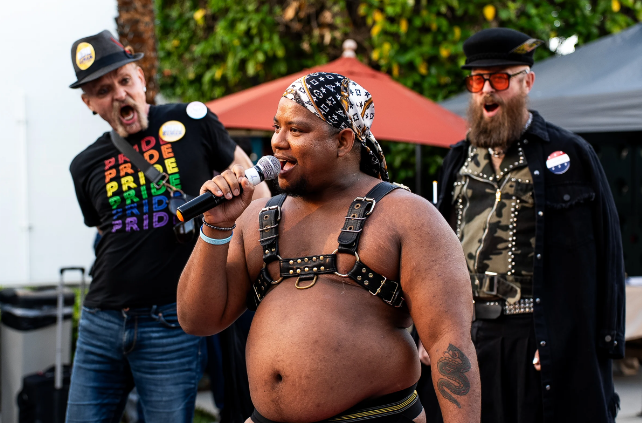
Speakers praised the celebration of International Whores’ Day as a return to the roots of Pride’s revolutionary origins and defiance of norms.
“The LGBTQ movement loves the image of rebellion, but historically it has often been deeply uncomfortable with the people forced to survive outside respectability,” said Sydney Rogers, the event’s keynote speaker and senior manager of the Trans Wellness Center at the LA LGBTQ Center. “There will be no modern LGBTQ movement without sex workers, without street queens, hustlers, homeless queer youth, ballroom children.”
Baloue, a historian of the U.S. ballroom scene, said much of what we now consider Gen Z slang emerged from underground Black and Latine LGBTQ subcultures where communities subverted and transgressed gender rules.
“‘Throwing shade’, ‘reading’, ‘clocking tea’ … these come mainly from trans women [in ballroom] who were sex workers and or are sex workers,” Baloue said.
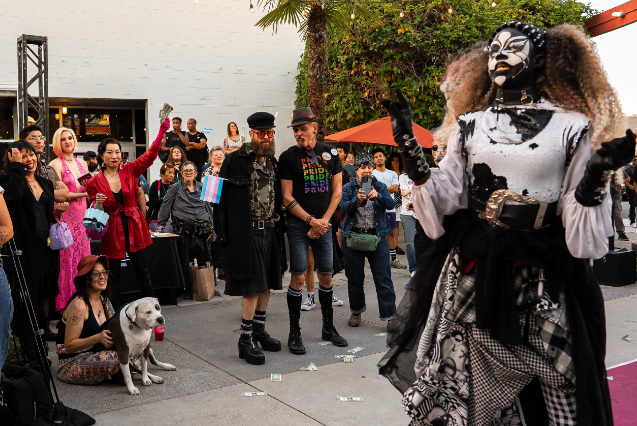
The intersection of queer identity and sex work has always been evident to Christianna Clark, a sex worker and the wellness director at Strippers United.
“Sex work is an overwhelmingly queer industry. I don’t know many straight sex workers, to be honest,” said Clark, who identifies as non-binary and also goes by the working name Selena.
In the commercial sex industry that caters toward men, Clark said they see the erasure of queer women and non-binary people who have to perform “straight for pay.”
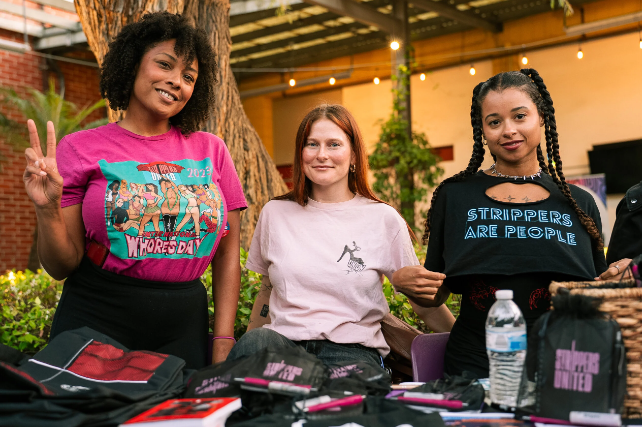
Panelists and organizers also spoke about how the informal sex economy has been historically more accommodating to communities like transgender people, those with disabilities, and undocumented people who might face job discrimination in the traditional workplace.
A thread of resistance was present throughout the night as organizations like NOlympicsLA and the Sex Worker Outreach Project tabled alongside the ACLU of Southern California to inform and educate sex workers about their rights in LA.
The ACLU published a sex worker rights guide for California to help sex workers understand state laws. Activists say the Golden State has made progress toward decriminalizing or removing the criminal penalties for prostitution to improve the health and safety of sex workers.
“We see sex work decriminalization as part of our reproductive justice work, our criminal justice work, our economic justice work, our racial justice work, because it really intersects with all of those different issues,” said Minouche Kandel, a senior staff attorney with the ACLU.
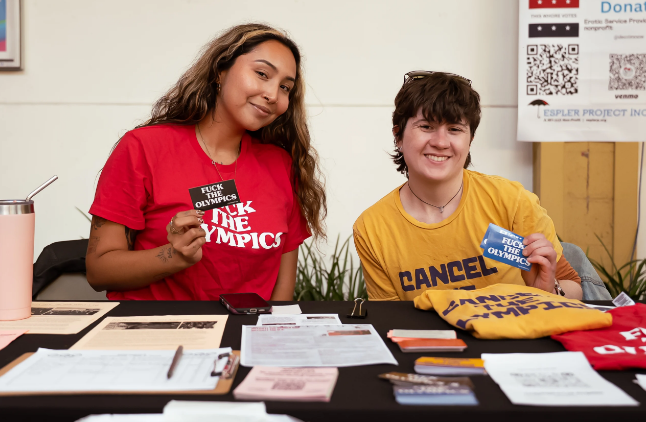
But across California and Los Angeles specifically, there have been significant rollbacks. In 2022, California lawmakers passed SB 357 to try to stop law enforcement officers from harassing and arresting people, especially trans women and women of color, for loitering with the intent to sell sex. But last year, the passing of AB 379 made it a crime for people to loiter with the intent to purchase sex — which critics say pushes sex workers into precarious situations.
“We’re very concerned with these big [sporting] events coming to LA, there will be over policing, over surveillance of all communities,” Kandel said, referring to the FIFA World Cup and 2028 Olympics. “We have huge fears that there will be efforts to move unhoused people off the streets, move sex workers off the streets in the guise of creating ‘safety’ for these events.”
While many in attendance at International Whores’ Day were sex worker activists, academics or historians, some people had simply stumbled into the event, like Stormi, who hangs out with friends nearby because she receives services from the LGBT Center.
What did she resonate with at the event? “Baby, I’m an international whore,” Stormi said, flipping her hair.
At 20 years old, Stormi said she’s still considered a baby doll — a young transgender woman. But she said she has always been deeply passionate about the art form of dancing as it relates to her identity as a queer person of color.
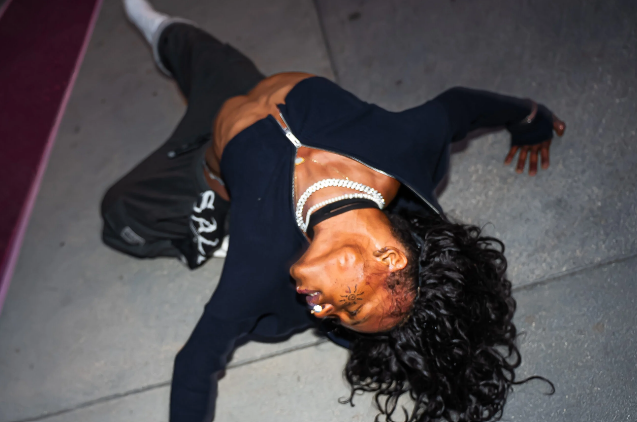
“I’m a ballroom girl, I’m really big on being in all sorts of things with my community,” said Stormi, who performs as Babi Storm in voguing competitions in LA and has trained in a variety of dance genres, including traditional Indian styles, kathak, and bharatnatyam.
In an unofficial performance at the end of the event, she duck walked, spun, and dipped, as a DJ played house music.
“I used to be a stripper too, I used to be in a club,” Stormi said. “It is seen as more semi-socially acceptable than having to be out on the street for necessities, selling the punani.”
Just like any industry, there are disparities within sex work, like segregation in strip clubs or the disproportionate number of Black trans women streetwalking to find clients. Even though Tuesday night’s event honored luminaries like Marsha P. Johnson and Sylvia Rivera — transgender women of color credited with championing the Stonewall Uprising — Stormi said she wanted to see more of that visibility in the attendance of the event.
“I was definitely the only like Black trans femme queen up in there, and then everybody else was fish,” she said, disappointed in seeing the absence of other Black trans women sex workers in the audience. Rogers and Fatima Malika Shabazz, a policy advocate at DeCrimSexWorkCA, were featured speakers who shared their experiences as Black trans women surviving and navigating sex work.
Baloue, the emcee, acknowledged the event still has more room to grow as the organizers hope to establish International Whores’ Day as an annual celebration to kick off Pride in LA for future years.
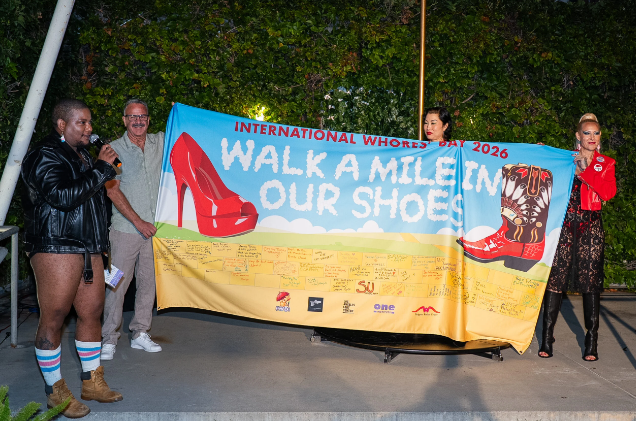
“We were working with really tough time constraints trying to pull the event together, we’re a small team, very underfunded,” said Baloue.
He wants organizers to attract more sponsors next year to build the capacity to engage more people. “In the middle of the week, it’s really hard to reach people, and the only way you can really effectively do that is just through more partnerships,” he said.
For Stormi, Pride is more than a parade with sponsored floats cruising down Santa Monica Boulevard in West Hollywood.
“Pride Month is about the T-girls, and the T-girls only,” Stormi said. “We are forgetting who, from the boot to the tit, bitch, who built this community.”