Originally published in L.A. Taco 9/22/2026
Stories include “Every Time I Whoop a White Man’s Ass, I Call It Reparations” and “Love, Mom,” a trans woman’s reflection on her past as a sperm donor.
By Lauren Bethke
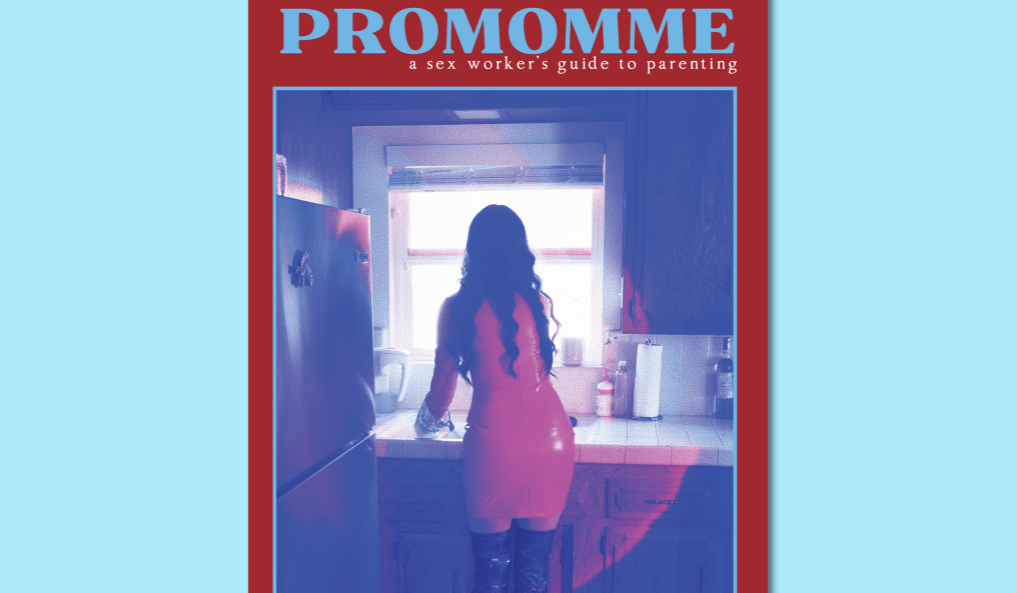
Kim Ye is the writer and filmmaker behind “ProMomme: A Sex Worker’s Guide to Parenting,” a documentary and magazine that explores what it’s like to raise children while working in the sex industry, something the world almost never gets to see represented honestly.
This has become a hotter topic in the media lately, with shows like TLC’s “The Double Lives of Suburban Wives,” which follows six married women in the St. Louis area who work in the adult entertainment industry. Here, the subject gets the reality-TV treatment: played up, dolled up, and at times turned into a spectacle.
“ProMomme” gives you another side of the story—the raw, complicated, and authentic reality of motherhood while working in the adult entertainment industry.
The cover image of the magazine is enough to stop you even before you crack it open: a woman at the sink washing dishes, her back to the camera, wearing a skin-tight red latex dress and thigh-high black latex boots.
As a parent myself, it spoke to me.
I’m a journalist, not a sex worker, but I spend a lot of time reporting on the community, enough that conversations with other parents can get a little awkward. In the school pickup line, someone will inevitably ask, “What kind of things do you write about?”
I keep it short and sweet and say, “The finer things in life.” That covers food, nightlife, and sex work without having to explain all of it while our kids are climbing into the backseat.
Reading “ProMomme” felt like finally getting to finish that conversation.
MEETING KIM YE
I spoke with Ye, the artist behind both the zine and the documentary.
“The ‘ProMomme’ zine came out of my work with SWOPLA (Sex Workers Outreach Project Los Angeles), which I got involved in after FOSTA-SESTA (Fight Online Sex Trafficking Act – The Stop Enabling Sex Traffickers Act) passed in 2018, changing the way I and my Pro-Domme colleagues advertise to this day,” she says.
Ye says her involvement with SWOPLA eventually led to the creation of “ProMomme.” In 2020, she successfully got pregnant with her first child and had a realization.
“Oh shit, my life and work are about to change forever,” she says.
She couldn’t find many resources about that transition from the perspective of sex workers.
“As part of SWOPLA’s sex worker-led research, we put together focus groups where we facilitated small-group conversations between parents doing sex work,” she says. “We were talking to people about finding the value of sex work when it comes to parenting, because we were wondering how the two informed each other.”
The questions included what about the job helped or limited a parent’s role in their child’s life, what value sex work had for parenting, and what a parenting magazine for sex workers might look like.
“This is where the ‘ProMomme’ zine came to life,” Ye says.
She points out that a lot of research about sex work focuses on violence and harm while leaving out other parts of people’s lives: happiness, consent, autonomy, community, and the skills people develop through their work. One thing that came up was how much the skills overlap.
Sex workers have to communicate clearly, set boundaries, read people, and understand consent. Those things are pretty useful when you’re raising a kid, too.
Sex workers have to communicate clearly, set boundaries, read people, and understand consent. Those things are pretty useful when you’re raising a kid, too.
“Due to this timing, volume two was able to include a transcription of the group interview from the film, which mimicked the original sex worker parent focus groups that all this came out of,” Ye says. “So this cross-pollination between the people involved and the relationship between different forms of media, from magazine to film, is important for weaving a web of sex-worker-driven narratives that can counter negative associations with us and our work in the larger culture.”
“I want to create durable change, and in order to do that, people have to hear these kinds of stories repeatedly, and in different formats,” she says.
“PROMOMME: A SEX WORKER’S GUIDE TO PARENTING” MAGAZINE
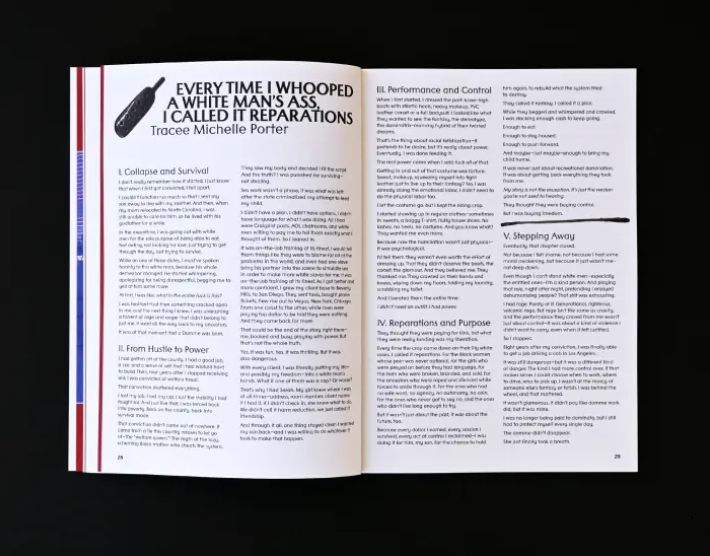
The essays, poems, and photographs in “ProMomme” will pull you in. Some will make you lean forward, some will make you laugh, and a few will strike so hard you’ll need to put it down and go for a walk around the block.
Sophia Coleman designed the zine using imagery inspired by vintage, atomic-family magazines, those old advertisements where every family seemed to have the same house, the same mom, the same dad, and the same two kids.
Tracee Michelle Porter‘s essay “Every Time I Whoop a White Man’s Ass, I Call It Reparations” was one of the hardest-hitting pieces in the collection. After a welfare fraud conviction cost her job, car, stability, and her son, she turned to sex work to survive. She eventually built a following as a dominatrix, traveling between cities to see white clients who paid to be degraded.
She writes about naming her sessions “reparations” and the complicated relationship she had with the persona she created.
“They thought they were paying for kink, but what they were really funding was my liberation,” Tracee writes.
Eventually, she left that part of the work behind. She wasn’t ashamed of it. She realized the persona wasn’t who she was underneath everything else.
“It was never just about recreational domination. It was about getting back everything they took from me,” she says. “My story is not the exception. It’s just the version you’re not used to hearing. They thought they were buying control. But I was buying freedom.”
“My story is not the exception. It’s just the version you’re not used to hearing. They thought they were buying control. But I was buying freedom.”
Today, she drives a cab in Los Angeles and works in policy and advocacy. The work looks different now, but she’s still fighting to get back what she feels was taken from her.
“I’ve learned something else, too: You don’t have to be in leather to make a man kneel,” she writes in a powerful line near the end of the piece.
The piece that stayed with me longest was “Love, Mom” by Tiffany <3. Before starting hormone therapy for her transition, which would mean she could no longer have biological children, the writer became a sperm donor. Her donation resulted in nine births, with two sets of siblings, between 2015 and 2019.
Tiffany <3 signed an identity-release agreement, meaning those children are able to contact her when they turn 18. In the meantime, she’s spent years wondering about them without knowing who they are.
Tiffany talks about how her relationship with the sperm bank has grown complicated. They paid her for DNA so people could have a family, and now she pays them to store her DNA in hopes of being able to have a family of her own.
“They feel like they’ve become the brokers of my ghosts—of family past, present, and future,” she writes.
“They feel like they’ve become the brokers of my ghosts—of family past, present, and future,” she writes.
From there, she brings up a documentary she once saw about Filipina nannies who leave their own kids behind to raise someone else’s, sending money home. If that counts as love, she asks, why doesn’t doing sex work also count as love?
She imagines meeting one of her biological children someday at a pizza place, hoping it would be a “Diet Coke day,” she says. She’d cry and worry that when they look at her, they’ll see exactly what she saw in her own father.
This story was one that made me put the zine down and have to go for a walk because it had moved me so deeply. That’s the power of mothers. They’re complex, they’re powerful, and they’re selfless.
Once you become a mother, society might see you as nothing more than a caretaker. As though you don’t get to have an identity outside of motherhood. Women aren’t always given much grace to have hobbies, personalities, careers, or even a sexuality of their own, and that burden gets even heavier when the career providing for your family involves sex.
My mind keeps going back to the cover. The woman is wearing latex and washing dishes. There is always laundry, school, grocery shopping, packing lunches, and that endless list of things that need to get done, followed by that little voice asking if you’re doing enough.
Motherhood can feel like a constant question of how you could do it better, what you could be doing more of, and how you’re supposed to give everything you have when you already feel like you’ve got nothing left.
Then there’s the other side of it. Society pushes the idea that women go from being sexually desired to being packed away once they have children—suddenly less sexy, less valuable.
“ProMomme” gives these women room to talk about sexuality on their own terms, including the complicated parts. Some are still working in sex; some are reckoning with how motherhood has changed their relationship with their bodies; some are figuring out who they are now. They can be caretakers and sex workers, exhausted and touched-out, disconnected and desired—and still hold an identity that belongs entirely to them.
That’s the contradiction “ProMomme” sits inside: You can have nothing left to give and still know motherhood is one of the most powerful things you’ve ever done.
Asked when we could expect new issues, Ye explained that the project depends on having the money to pay its contributors.
“Readers have the opportunity to contribute to the sustainability of the project by donating to SWOPLA,” she says.
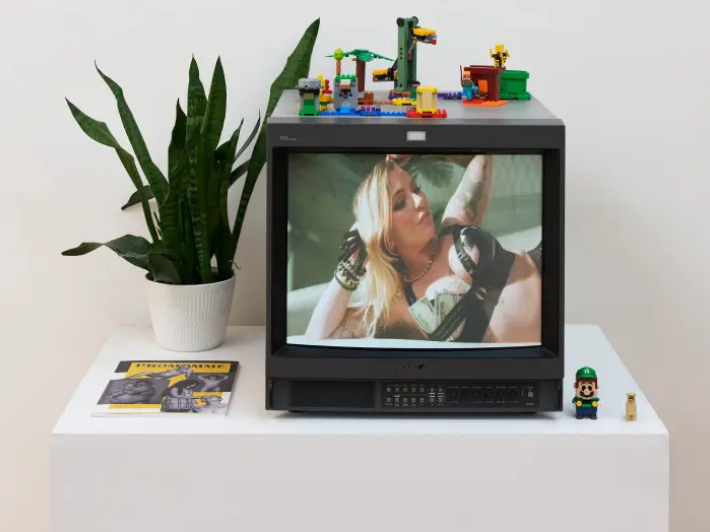
“THE SEX WORKER’S GUIDE TO PARENTING” DOCUMENTARY
While preparing volume two of her print publication, Ye was also finishing “The Sex Worker’s Guide to Parenting,” a documentary in the process of being considered by festivals for 2027. The documentary captures the publishing process of the original zine and features some of its contributors.
The film opens with Ye’s baby splashing their toes in pool water. Before you see the work she does, you just see a parent with their kid.
Viewers follow six parents working in the sex industry—Sorceress Bebe, Ella Lin, Lorde Destroyer, Lotus Lain, Sweet Rosie, and Ye herself—along with Dr. Kimberly Fuentes, director of research at SWOPLA, and Sophia Coleman, the zine’s graphic designer.
Each parent comes to motherhood from a different place. Some talk about protecting their children from the stigma attached to their work. Others see sex work as something that has given them the freedom, flexibility, or financial stability to be the parents they want to be.
There are conversations about childcare, sexuality, boundaries, judgment, and what it means to raise a child while knowing the outside world may never see the full picture of your life.
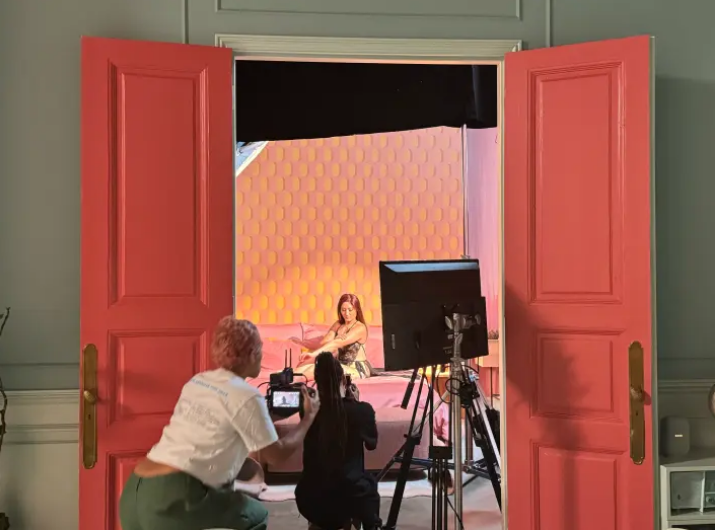
Ye’s story makes that especially apparent. She’s raising a three-year-old and a nine-month-old while making a film about the exact life she’s living. She talks about feeling disconnected from her body and sexuality after having a baby, then takes us into her dungeon, which doubles as her office.
It all felt so ordinary—parents were talking about school drop-offs, childcare, their kids’ futures, their own bodies, and the complicated business of trying to make a living while raising a family. The sex work is an important part of their lives, but it isn’t the only thing happening in them.
I finished “ProMomme” wishing there were more honest conversations like these—people who work in the industry are also parents, partners, friends, artists, and people trying to figure their shit out, just like the rest of us.
To keep up with documentary screenings and zines, follow “The Sex Worker’s Guide to Parenting” on Instagram.